
Peachtree City Golf Cart Mudrooms: Scratch-Resistant Luxury Vinyl Tile for Wet Pavement Grime
The floor inside a Peachtree City cart garage door takes wet grit every single day, and the floor we recommend for it is luxury vinyl tile. In plain terms, that is a stone or ceramic look printed under a clear protective layer at least 20 thousandths of an inch thick. It is glued down to the concrete, and the gaps between tiles are either closed tight or filled with a flexible colored grout, the filler that packs the joints between tiles. Each part of that description does a job. Once you know what each part does, you can pick up a sample in our showroom and read it like a spec sheet.
Peachtree City is built around its paths. The city puts its network of shared-use paths at more than 100 miles, and for many households the cart is the everyday way to reach school, the course, and the grocery store. Every one of those trips ends at the same door. The cart stays in the garage, but whatever the path was carrying comes inside on shoes, paws, and golf bags, and most of it lands on the first few feet of floor.
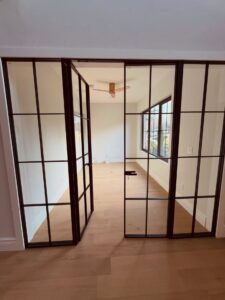
The hall in the photo below is from one of our recent installs, and you can see more of our projects on our Instagram page. Wide planks run through a pair of steel-and-glass doors without a break, and that unbroken look from one room to the next is what we aim for between a cart garage door and a kitchen. The difference is what the first few feet inside that door go through. The tile there has to be chosen for the abuse and matched to the kitchen for the look, which is why we treat the mudroom floor as its own decision.
Why cart path grime wears out a floor faster than foot traffic
Cart path grime wears a floor out faster than ordinary foot traffic because it arrives wet and sharp, and wet grit grinds. An asphalt path is stone chips held together with tar, and as it ages it sheds fine mineral grit. The sandy shoulders and the course bunkers add more. Much of that grit is quartz, the hardest common mineral in sand.
Quartz sits at 7 on the Mohs scale, a 1-to-10 ranking of how easily one mineral scratches another, where talc is 1 and diamond is 10. A steel knife blade sits near 5.5, so a grain of sand will scratch steel. It will scratch most floor finishes too. When a wet golf shoe presses that grain into the floor and drags it along, the finish loses.
Water makes it worse in two ways. It glues the grit to shoe soles so more of it makes it indoors, and it carries the red of Georgia clay along with it. That red is iron oxide, the same compound that turns an old nail orange, which is why it stains anything porous. Pine straw adds a fine brown dust that settles into any gap it can find, whether a grout line or the small bevel along a plank’s edge.
Put grit, clay-stained water, and pine straw dust together at a door that opens many times a day, and you have a job no ordinary hallway floor is built for. Hardwood finishes scratch and gray-stain along the threshold. Laminate swells at its seams. Ceramic tile holds up while its grout turns orange. Luxury vinyl tile scratches less, does not swell, and has no cement grout to stain, and the reason is in how it is built.
Why we recommend luxury vinyl tile over ceramic tile, hardwood, or laminate at this door
Luxury vinyl tile keeps the look of stone or ceramic and removes the two things that fail at a cart garage door: porous grout and a brittle surface. The “luxury” in the name is marketing. What matters is the construction, which is a stack of three layers:
- A core that gives the tile its body. In tile that is glued to the slab, the core is dense vinyl. In the click-together rigid version, it is stone plastic composite, which is ground limestone mixed into vinyl, so much of the tile’s weight is actually rock. Neither version absorbs water.
- A design layer, which is a high-resolution photograph of stone, ceramic, or wood printed on a film and bonded to the core. That printed layer is why a good vinyl tile can pass for travertine from a few feet away.
- A wear layer, a clear protective layer on top that takes the scratches so the picture underneath does not. Its thickness is the first number to check on any sample.
Tile-shaped pieces, usually 12 by 24 inches or 16 by 16, are sold as luxury vinyl tile. Plank-shaped pieces are luxury vinyl plank, and they are built the same way.
Ceramic and porcelain tile is what most people picture in a mudroom, and the surface itself is hard to beat. Ceramic tile is clay that has been shaped and fired, which means baked in a kiln at around 2,000 degrees Fahrenheit until it turns rock-hard. The glaze on top is a thin layer of glass melted onto the clay, and glass does not scratch easily. The weakness is everything around that glaze.
- Cement grout is porous. Cement cures with thousands of tiny channels running through it, like a very hard sponge, and dirty water wicks into those channels and stays. That is why grout makers tell you to seal grout and reseal it every year or two, and why red clay finds its way in anyway.
- Fired tile is cold underfoot in January, because dense clay pulls heat out of bare feet quickly.
- Fired tile is brittle. A dropped club head or a steel dog bowl can crack a tile, and a replacement from a later production run rarely matches the color of its neighbors.
Hardwood has the opposite problem. Its finish is far softer than quartz grit, so the path from the garage door wears dull first, and water standing at the threshold works into the wood and turns it gray. Laminate seems like the answer until water reaches it. Its core is wood fiber pressed with glue, and wood fiber soaks up water and swells like a dry sponge. Once it has swollen, it never lies flat again.
Vinyl is a plastic, and plastic does not take on water. That one fact is why a vinyl tile shrugs off a dripping golf bag, a tipped dog bowl, and the moisture that rises through a concrete slab. The tile itself does not care about slab moisture; the adhesive under it does, which is why we test the slab before we glue anything down. The same construction is why rigid core planks work in the lakeside lower levels covered on our Peachtree City luxury vinyl page. On top of that, vinyl is warmer than fired clay, quieter under traffic, and a single damaged tile can be cut out and replaced.
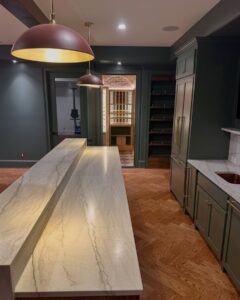
The herringbone floor in the scullery below, from one of our projects, is a layout people often ask us to carry into a mudroom. The floor in this room is wood. In luxury vinyl plank and tile you get the same herringbone on a surface that does not mind a dripping golf bag, which is the version we would put inside a cart garage door.
How to read a luxury vinyl tile spec sheet for a mudroom
Four lines on a luxury vinyl tile spec sheet decide how it holds up at a cart garage door: the wear layer, the core and how the tile is installed, the surface finish, and the edges. Here is what each one means and what we recommend for this room.
Wear layer
The wear layer is the clear protective layer on top of the tile, and it is measured in mils. A mil is one thousandth of an inch, so a 20-mil wear layer is about half a millimeter, roughly the thickness of five sheets of printer paper. That sounds thin, and it is, which is why what sits on top of it matters as much as the thickness.
The wear layer itself is clear vinyl. Over it, the factory applies a thin coating of urethane, a hard clear finish like the one on a hardwood floor, with mineral particles mixed in. Those particles are usually aluminum oxide, which in its crystal form is the mineral sapphires are made of, or tiny ceramic beads. Aluminum oxide sits at 9 on the Mohs scale, two steps above quartz, which is why sand dulls this coating far more slowly than it dulls a hardwood finish.
Tiles made for bedrooms and closets carry 6 to 12 mils, because nothing in those rooms grinds on the floor. Twenty mils is the standard for busy homes and light commercial spaces such as small shops, and heavy commercial floors go to 28 mils and beyond. For any floor inside a cart garage door, we hold the line at 20. Our earlier post on wear layers for golf cart living goes deeper into the mil ratings if you want the detail.
Core and how the tile is installed
Luxury vinyl tile comes two ways, and the choice decides how the floor goes in.
- Glue-down tile, also called dryback, is a flexible tile with a dense vinyl core. Our installers spread adhesive on the concrete and set each tile into it, so every tile is bonded to the slab.
- Rigid core tile has the stone plastic composite core described above and a click joint along each edge. The tiles lock together into one large sheet that rests on the slab without being attached to it, which is called a floating floor.
For a mudroom we recommend glue-down, for three reasons. A glued tile cannot shift under a rolling cooler or a loaded hand truck. There is no air gap beneath it, so it has no hollow sound. And because each tile is fixed to the slab, a bench or a wall of lockers can sit on top of the finished floor.
A floating floor cannot do that last part. It expands and contracts a little with temperature, as one big raft, and anything screwed down through it pins the raft in place so it buckles somewhere else. The one case where we steer toward rigid click tile is a mudroom that opens onto a floating plank floor in the kitchen. If both come from the same product line, the two can lock together and move as one. Floors from different lines, floating or glued, need a transition strip at the doorway. Our vinyl installation page compares glue-down and floating floors in more detail.
Surface finish
Choose a low-gloss finish with a light texture. Gloss is how much light a surface bounces straight back at you, and a scratch shows up as a break in that reflection. A matte finish scatters light in every direction to begin with, so a fine scratch has nothing to interrupt and disappears. Texture does a second job: it gives wet shoes something to grip.
Look for the words “embossed in register” on the sample, which means the texture was pressed to line up with the printed pattern. A stone look then feels like stone exactly where it looks like stone, instead of carrying a generic bumpiness that gives the vinyl away.
Sun is the last thing to check about the finish. The ultraviolet part of sunlight slowly breaks down the pigments in the printed layer, and most vinyl warranties exclude fading from direct sun. For an entry with a glass door, ask for a tile whose finish includes a UV inhibitor, which works like sunscreen for the floor, and plan a shade for the brightest hours.
Edges and grout
Tight-joint tiles have a small bevel along each edge and butt together with no grout. A bevel still catches a little dust, but far less than a grout line does. Groutable tiles leave a narrow gap that is filled with a flexible acrylic or urethane grout. That grout is a plastic rather than a cement, so it bends with the tile and does not need sealing. Either works at a cart garage door. What we steer people away from is a bright white grout line at an exterior door, whatever the grout is made of. The color and pattern of the tile itself matter more, and they are the next decision.
Which colors and patterns hide cart path grime best
Mid-tone stone looks with some movement in the print hide cart path grime best, because red clay dust and pine straw disappear into a surface that already has variation in it. Bright white shows every footprint. Near-black shows every dried water spot. The comfortable middle is warm greige, taupe, or a limestone or travertine look with a little veining.
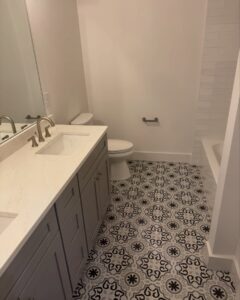
Pattern does the same job more decisively. An encaustic-style tile, named for the old patterned clay and cement tiles with color worked into their surface, carries so much design of its own that a little debris never registers. The bathroom in the photo below, from one of our installs, shows how a strong black-and-white pattern holds a small wet room together. The floor is the whole design, and nothing else in the room has to compete with it. In a mudroom we usually set a pattern like this as an inset, bordered by a plainer tile, so it reads as a built-in rug exactly where wet shoes land.
Size and direction change how a small room feels. A 12-by-24-inch tile has far fewer joints than 12-inch squares over the same floor, and fewer joints means fewer places for grit to collect and a calmer look. Rectangles laid the long way stretch a room; laid across it, they make it feel shorter. In a narrow back hall, squares set on the diagonal pull the eye across the width and make the hall feel wider than its walls.
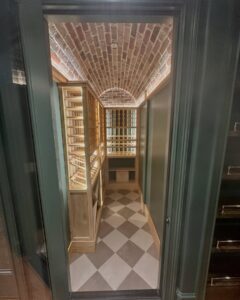
A checkerboard does that and adds a pattern that has read as classic for centuries. The one in the photo below is from the same house as the scullery above, laid on the diagonal beneath a brick barrel vault on the way into a wine room. In luxury vinyl tile the same look is two colors of 12-inch tile set corner to corner, with a colored grout or tight joints in place of cement.
Whatever look you land on, hold the sample next to your kitchen floor before you decide. You will see the two floors together from the kitchen every day, and a warm tile beside a cool gray plank, or the reverse, is a mismatch you will notice every time you walk in. That raises the question of where one floor should end and the other begin.
How the floor should run from the cart garage door to the kitchen
Run one surface from the exterior door to the kitchen opening, and give the places where that surface meets another floor as much thought as the tile itself. Most of the trouble we see in older mudrooms is at the edges: a lip at the garage door that catches a toe or a rolling cooler, a loose strip at the kitchen, or a bare tile edge under a bench where water sits.
Height is the first thing to sort out, because vinyl tile is thinner than almost everything it meets. Glue-down tile is 2 to 4 millimeters thick, and rigid click tile is 5 to 8. The floors next door are usually taller:
- Solid hardwood is three quarters of an inch thick, about 19 millimeters.
- Engineered hardwood runs three eighths to five eighths of an inch, about 10 to 16 millimeters.
- Porcelain tile set in mortar lands near 12 millimeters.
There are two ways to close that gap. The first is a reducer, a strip of molding shaped like a shallow ramp that slopes from the taller floor down to the shorter one. A flush reducer is the version where the top of the ramp sits level with the taller floor, so there is no lip at all, only a gentle slope. The second way is to build the mudroom slab up with a leveling compound, a pourable cement that sets hard and flat, until the two floors meet at the same height. We prefer the second where the slab allows it, because nothing is left to catch a toe. At the exterior door itself, a low metal or vinyl threshold strip seals the gap under the door and gives a wet shoe nothing to trip on.
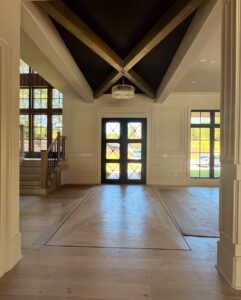
The foyer in the photo below is from a project we shared on Instagram in September, and it is also on our Facebook page. Planks run from the front doors through the main level without a step or a strip, and a bordered inlay marks the entry. A cart-path home has two front doors, and the back one gets more use. A limestone-look tile in the same warm undertone as planks like these, meeting them flush at the kitchen opening, keeps that flow going when you come in from the garage instead of the porch.
Built-ins come next, and the order of work depends on which tile you chose. With glue-down tile, the floor goes in first and the bench, cubbies, and locker wall sit on top of it, so no bare tile edge is left anywhere water can reach. With a floating click floor the order flips. The bench and lockers are fixed to the slab first and the tile is cut to meet them. A small gap, hidden under the toe kick (the recessed strip at the foot of a cabinet), lets the floor move.
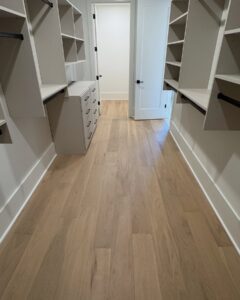
The storage wall in the photo below is from another of our installs. It is a closet rather than a mudroom, and it is the detail we point to when we plan a locker wall: the finished floor runs wall to wall under the shelving and drawers. Build a mudroom the same way and the first wet boot of the morning lands on tile instead of on the base of a cabinet.
One more door deserves the same treatment. If your cart garage is detached, the walk from the cart ends at a back door or a patio slider, and that doorway is the real mudroom whether or not it carries the name. Give it the same tile and the same threshold, and because a slider lets in far more sun than a solid door, choose the UV-inhibiting finish described above.
What installation involves on a Peachtree City slab
Installation on a slab starts below the tile, with the part of the job you never see once the floor is down. Many Peachtree City homes sit on a poured concrete slab, and concrete passes ground moisture upward even when it looks bone dry. Our crews test the slab’s moisture first and match the adhesive to the reading, because every adhesive has a moisture limit it will tolerate before it lets go.
Flatness matters as much as moisture. A glue-down tile follows every bump and dip in the concrete beneath it, so our crews grind down the high spots and fill the low ones with leveling compound until the slab is flat. That groundwork is the difference between a floor that looks like stone and one that looks like vinyl.
The room also has to be heated and cooled like the rest of the house, before the install and after it, because vinyl grows a little in heat and shrinks in cold. A mudroom-sized room is usually a one- or two-day job including the slab work, and we handle the old floor removal, the furniture moving, and the trim. A few questions come up on almost every mudroom estimate.
Questions we hear about mudroom floors in Peachtree City
Is luxury vinyl tile waterproof enough for a door that opens onto the cart path?
Yes. The tile itself is unaffected by water from above or below, and a glue-down installation leaves no hollow under it for water to pool in. Water can still travel along an open joint or under a loose threshold, so the sealant at the door and a flexible grout matter as much as the tile does.
Can the same tile go into the golf cart garage itself?
Usually not. Luxury vinyl is an interior product, and most manufacturers, COREtec among them, want the space held between about 55 and 85 degrees before, during, and after installation and for the life of the floor. An unconditioned garage swings well outside that range every summer and winter, so the tile starts at the door and the garage keeps its concrete, an epoxy coating, or a rubber mat.
Can luxury vinyl tile go over the ceramic tile already in my mudroom?
Often, yes, and it saves a day of demolition. Glue-down tile needs a smooth, firmly bonded surface, so the old grout lines are filled with a thin skim coat of leveling compound before the new tile is glued over the top. Rigid click tile can float over old tile that is flat and sound. Either way the added height is small, because the new floor is only a few millimeters thick.
How do you clean cart path grit off it?
Sweep or vacuum with a hard-floor head, then damp mop with a cleaner made for vinyl. Skip steam mops, which can soften the adhesive under a glue-down floor, and skip rubber-backed mats, which can leave a yellow stain on vinyl over time. Use a door mat with a vinyl-safe backing instead. Our vinyl care page has the full routine.
Plan your mudroom floor with Select Floors
We have sold and installed floors from our showroom at 1890 W Oak Parkway in Marietta since 2004, across more than 5,000 local homes. The crews who will lay your tile have been with us for more than a decade. Bring a photo of your mudroom and your kitchen floor to our showroom and we will pull tile samples to hold against them. Or schedule your free in-home estimate and we will come to Peachtree City, measure the room, check the slab, and bring the samples to your door. Our flooring services in Peachtree City page covers the rest of the house.
In-Home Estimate
Fill out the form below and a member of our team will be in touch shortly.
"*" indicates required fields