
Marietta Dining Room Flooring: Hardwood Planks That Handle Heavy Holiday Chairs
A dining chair is the hardest thing a hardwood floor lives with, and the dining room is where a floor either proves itself or starts to look tired after one season of holiday dinners.
Chairs are harder on a floor than feet. A person walking spreads their weight across a shoe sole and lifts it with every step. A seated person puts the same weight onto four small chair feet and then drags those feet across the finish every time they sit down, lean back or stand up. Multiply that by every seat at the table and every dinner from Thanksgiving to New Year’s, and the dining room ends up with more concentrated wear than any other room in a Marietta home.
Hardwood flooring handles that wear well, but only when three choices are made with chairs in mind: the kind of wood, the finish on top of it, and the way the boards are laid. The rest of this post walks through those three choices, how they play out in the Georgia climate, and how we schedule a dining room install so the floor is ready before the first guests arrive.
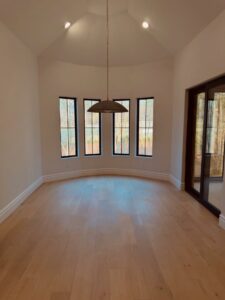
The room below is one of our recent installs, shared on our Instagram page. Wide oak-tone planks run toward a bay of tall windows under a single pendant light, and the table and chairs had not arrived yet, so you can see every board the chairs will eventually sit on.
What a dining chair does to a floor
Start with the numbers, because they explain everything that follows. A 180-pound adult on a 15-pound chair puts close to 200 pounds onto four chair feet, which works out to about 50 pounds on each one. Each foot rests on a glide, which is the small cap, pad or button on the bottom of a chair leg that touches the floor. Most glides are smaller than a quarter, so 50 pounds is pressing on a spot about the size of a coin, and that spot slides across the finish every time the chair moves.
What the glide is made of decides what happens next. A felt pad spreads the load and slides over the finish without cutting into it. A hard plastic or metal glide concentrates the load on a sharp edge and scrapes a fine line into the finish on every move. Grit makes either one worse. Red clay and pine straw tracked in from a Cobb County driveway settle under chair legs, and once a chair drags over that grit, the grit works on the finish like fine sandpaper.
A tipped chair adds one more kind of damage. A chair rocked back onto two legs puts a person’s whole weight onto two points instead of four, and that is the load that dents softer woods rather than scratching the finish. So a dining room floor faces three separate attacks: scratches from sliding, scouring from grit, and dents from tipping. The wood you choose handles the dents, and the finish handles the rest.
Which woods shrug off chair legs
Dents come down to how dense the wood is, and the flooring industry measures that with a test called the Janka hardness test. A steel ball about the size of a marble is pressed halfway into a board, and the force needed to get it there is the Janka rating. A higher number means a harder wood, and for a dining room the numbers sort the common species into clear groups:
- White oak, about 1,360: hard enough to resist chair dents, and the wood we install most often in dining rooms around Marietta.
- Hickory, about 1,820: the hardest domestic wood we sell, with bold color variation that hides wear well.
- Hard maple, about 1,450: hard, but its smooth, even grain shows scratches more readily than oak.
- Walnut, about 1,010, and cherry, about 950: beautiful, but soft enough that a tipped-back chair can leave a permanent mark.
Hardness is only half the story, because most of what a chair leaves behind is a scratch in the finish rather than a dent in the wood. Here the pattern of the grain matters as much as the density. White oak has an open, linear grain full of fine lines running the length of each board, and a scratch that lands among those lines blends in with them. Maple has a tight, uniform grain with few lines, so the same scratch sits on a plain background and stands out. That combination of hardness and busy grain is why we suggest white oak first when you come in for a dining room, and why we wrote a separate guide to European white oak for traditional Cobb County brick homes. Hickory suits a more casual, farmhouse-style dining space where its two-tone boards fit the look.
What “wire-brushed” and “hand-scraped” mean, and why they hide scuffs
With the wood chosen, the finish decides whether the scratches that do happen ever show. Two things about a finish matter here: how much shine it has, and whether the surface under it is smooth or textured.
Shine first. A glossy finish is smooth enough to reflect light in one direction, like a window, which is why a chandelier shows up as a bright patch on a glossy dining room floor. A scratch breaks that smooth surface and scatters light in every direction, so it shows up as a pale line against the shine. A matte finish is already scattering light everywhere, so a scratch in it has nothing to stand out against. Finish makers measure shine with a gloss meter, which bounces a beam of light off the surface and records how much comes straight back, and the floors sold as matte return the least. For a dining room we recommend the lowest sheen the maker offers.
Texture adds a second layer of camouflage, and two words come up on every sample board. Look closely at an oak board and you can see the grain as alternating bands: every year the tree adds one lighter band of softer wood in spring and one darker band of harder wood in summer. A wire-brushed board has been run under stiff steel brushes at the factory, which wear away a little of the soft spring bands while the hard summer bands stay put. What is left is a faint texture of shallow grooves that follow the grain, and small scratches settle into those grooves instead of lying on top of a flat surface. A hand-scraped board is different: a blade has been drawn across the width of each plank to leave long, shallow scoops, which gives a more rustic look and breaks up reflections in the same way. Our guide to hand-scraped and wire-brushed textures goes into how each one looks in a room. For a dining room, a light wire-brushing is the one we suggest most, because it hides glide marks without pushing the room rustic.
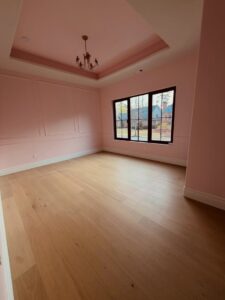
The dining room below, from the same project as the photo at the top of this post, shows what low sheen does under a chandelier. The planks sit in direct light from the fixture and the window, and instead of a bright reflection you see the grain of the boards, which is exactly the surface that keeps chair scuffs out of sight.
Why a factory finish outlasts one brushed on in your dining room
The finish can go on in two places: at the factory before the boards ship, or in your home after the boards are laid. For a room full of chairs the factory finish wins on wear, and the reason is worth knowing.
A factory line applies several very thin coats of urethane, the clear protective coating used on most wood floors, and hardens each coat in seconds under ultraviolet lamps. Those coats carry tiny particles of aluminum oxide, a mineral so hard it is used as the grit on sandpaper. The result is a surface that is harder than the wood under it and cured all the way through before the board leaves the plant. A finish brushed on in your dining room hardens by drying in open air over several days, with no mineral in it, and that is why a site-finished floor shows chair marks sooner than a prefinished one with the same wood underneath.
Prefinished boards do bring one detail to decide on. Because each board is finished before it is laid, the factory cuts a small angled edge, called a bevel, along each side so the edges do not chip. A deep bevel leaves a groove between boards where crumbs and grit collect, so for a dining room we recommend boards with a micro-bevel, which is a bevel so slight you feel it more than see it, or a square edge with no bevel at all.
Solid or engineered under the table
Both the wood and the finish come in two kinds of board, and the choice between them matters more in Georgia than in most places.
A solid board is one piece of wood from top to bottom, usually three-quarters of an inch thick. An engineered board has a layer of real hardwood on top, glued to a base of thinner wood layers running in alternating directions. Both take the same finish and look the same from above, and both shrug off chairs equally well when the species and finish are right. The difference is how they behave when the air changes.
Wood takes in moisture from the air and gives it back, swelling a little as the air gets damper and shrinking as it dries. How much moisture the air holds is called relative humidity, and wood floors do best when it stays between 30 and 50 percent indoors. Marietta pushes both ends of that range: a humid summer can lift indoor humidity toward 70 percent even with the air conditioning running, and a furnace running through December can drop it into the 20s. A solid board moves with every swing, and a wide solid board moves most, opening small gaps in winter and closing them in summer. An engineered board’s crossed layers hold the top layer still, so it moves a fraction as much. That stability is why we recommend engineered boards for any plank wider than about five inches, and for any home built on a concrete slab, where moisture can rise through the concrete.
Solid boards still have their place. In a home with a crawlspace and a wood subfloor, which is common in Marietta’s older neighborhoods, a solid oak floor in a moderate width can be nailed down and sanded and refinished several times over its life. A good engineered board can be refinished too, as long as its top layer is thick enough; we look for a wear layer of 3 millimeters or more, roughly the thickness of two stacked quarters, so the floor can be renewed through hardwood refinishing after years of chairs rather than replaced. Our estimator checks which foundation and subfloor your dining room sits on during the in-home visit, and our guide to solid versus engineered planks covers the trade-offs in more depth.
How wide, and which way the boards run
With the board chosen, two layout decisions change how chair wear reads across the room, and neither one costs anything extra.
The first is direction. Most of a chair’s travel is in and out from the table, so run the boards the same way the chairs move. A scratch that runs along the grain of a board lands among the grain lines and blends in, while a scratch that cuts across the boards crosses every grain line and every joint and shows up as a mark. Boards that run toward the room’s main window help in the same way, because light traveling along them leaves the joints between boards almost invisible.
The second is width. Every joint between boards is a line, and a narrow strip floor puts a lot of lines under a table, which looks busy and gives crumbs more places to settle. Boards in the five-to-seven-inch range calm the floor down and suit the proportions of a formal dining room, and most of the floors in our hardwood inspiration gallery sit in that range. The trade-off is the one from the last section: wider boards move more with humidity, which is why we pair wide planks with engineered construction.
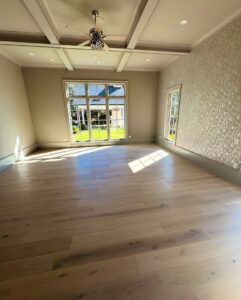
The formal dining room below, from one of our custom-home installs shared on Instagram, shows both decisions at once. Wide planks run the length of the room toward the French doors, so light and chair travel both follow the boards, and the coffered ceiling and wainscoting sit on a calm floor with very few lines in it.
One more layout point matters where the dining room opens onto the rest of the house. A single plank run from the dining room into the foyer or kitchen, with no transition strip at the doorway, keeps the floor reading as one surface and leaves nothing for a chair leg to catch on. If the kitchen has stained wood cabinets, stain colors matched to existing wood cabinets keep that run looking planned rather than accidental.
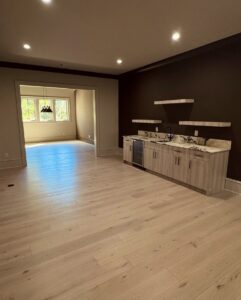
The photo below, from the same project as the formal dining room above, shows that continuity in practice: the same planks run from a butler’s pantry straight into the dining room, under the chandelier, without a break at the doorway.
Rugs, felt pads and a word about rubber
A few furniture choices do as much for the floor as the boards themselves, and they cost very little.
- Felt pads on every chair foot. Felt is the one glide material that slides without cutting, and it is worth replacing the pads each autumn, because felt packed with a year of grit stops protecting the floor.
- A rug big enough that the chairs stay on it when pulled out, which usually means the rug extends about two feet beyond the table edge on every side. A custom area rug cut to the room avoids the chair that sits half on and half off the rug’s edge.
- Chairs with wide feet or sled bases, which spread the weight over more floor than narrow, tapered legs with metal caps.
One rug detail surprises people. Rug pads with rubber or vinyl backing contain plasticizers, the chemicals that keep rubber and vinyl soft, and over months those chemicals migrate out of the pad and into the finish, leaving a cloudy or yellowed shape where the rug sat. Georgia’s warm, humid summers speed that up. A felt pad, or a felt pad with natural rubber on one side, holds the rug in place without the chemistry, and it lets the floor age evenly under the rug.
How we schedule a dining room before the holidays
A single dining room is one of the quickest hardwood jobs we do, but the calendar has a few fixed parts, and we plan them around your first dinner.
The boards come to your house a few days before our crew does. Wood settles to the moisture level of the room it lives in, so we bring the planks inside with your heat running at normal winter settings, and our installers check both the boards and your subfloor with a moisture meter before the first board goes down. Wide planks get a stricter check than narrow ones, because they have more room to move. Our hardwood installation page lists what to clear out and what to expect on install day.
Prefinished boards are the fastest route. Once the boards have settled, laying a typical dining room takes our crew about a day, and the table and chairs go back that evening because the finish is already cured. A site-finished floor takes longer: sanding, stain and two or three coats of finish add several days, then the floor needs about a week before heavy furniture returns and two to three weeks before rugs go down. If the first guests arrive in late November, a prefinished floor is the one that fits.
Our showroom at 1890 West Oak Parkway in Marietta has full-size planks you can set beside a photo of your table and chairs, and the in-home measure that follows confirms the subfloor, the moisture readings and the transitions before we set a date. Flooring financing spreads the cost of a pre-holiday install over the months that follow.
Plan your dining room floor with Select Floors
We have completed more than 5,000 flooring projects across Cobb County and North Metro Atlanta over the past two decades, and dining rooms in Marietta’s older colonials and ranches are a regular part of that work. Bring a photo of your table and chairs to our Marietta showroom and take a few white oak and hickory samples to the window, or browse the hardwood products catalog to narrow down species and finish first. When you are ready, request your free in-home estimate and we will measure the room, test the subfloor and give you an install date that lands before the first guests arrive.
In-Home Estimate
Fill out the form below and a member of our team will be in touch shortly.